New Construction vs. Resale Homes in Raleigh & the Triangle: Which Is Better in 2026?
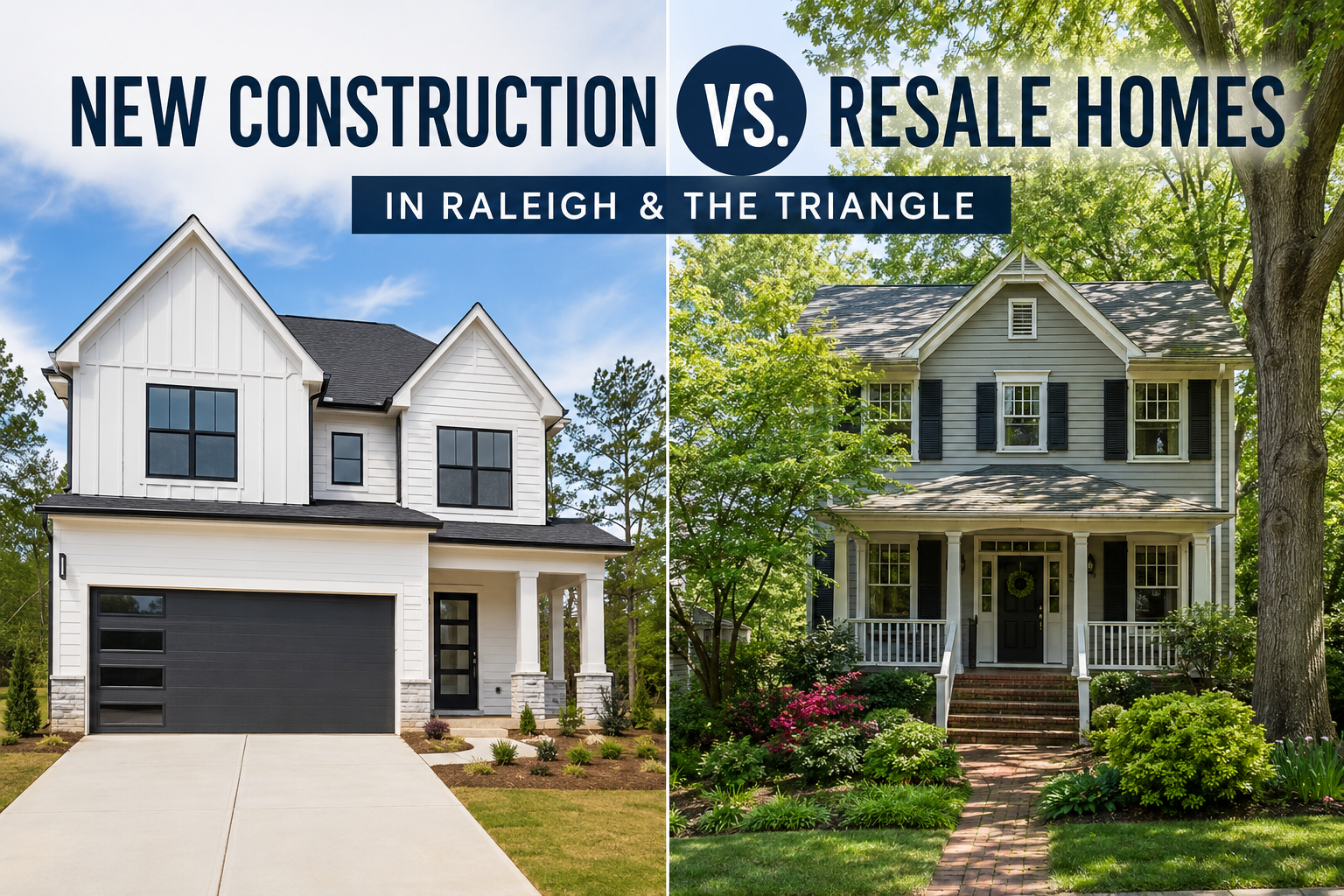
New construction and resale homes each offer different advantages. Triangle buyers should compare incentives, location, lot size, monthly payment, upgrades, and long-term value before deciding.
If you are buying a home in Raleigh, Cary, Apex, Holly Springs, Fuquay-Varina, Wake Forest, Sanford, or another Triangle community, one of the biggest decisions you may face is whether to buy new construction or a resale home.
Both options can be excellent.
Both can also come with tradeoffs.
New construction may offer modern floor plans, builder warranties, new systems, energy-efficient features, and financing incentives. Resale homes may offer established neighborhoods, larger lots, mature landscaping, finished improvements, better locations, and more room for negotiation.
The right choice depends on your budget, monthly payment, lifestyle, commute, desired location, lot size, tolerance for maintenance, financing, and long-term plans.
Blair Whelan with eXp Realty helps buyers throughout Raleigh and the Greater Triangle compare new construction and resale homes based on the full financial and lifestyle picture, rather than simply deciding based on which property looks newer.
The better question is not:
“Is new construction better than resale?”
It is:
“Which option gives me the best overall value for my specific situation?”
What Is Considered New Construction?
New construction generally refers to a home that has recently been built and has not previously been occupied as a traditional resale property.
Depending on the community, buyers may encounter several types of new construction.
Move-in-ready or inventory homes
These homes are already complete or close to completion.
The builder has usually selected most of the finishes.
For buyers who want a newer home but do not want to wait months for construction, inventory homes can be attractive.
Homes under construction
The home has already started but may still allow limited design selections depending on the construction stage.
To-be-built homes
A buyer selects a homesite and floor plan before construction begins.
Depending on the builder, buyers may be able to choose structural options, design selections, flooring, cabinets, countertops, lighting, and other finishes.
Townhomes and attached homes
New construction in the Triangle is not limited to detached houses.
Many growing communities include townhomes and other attached housing that may provide a lower entry price than detached new construction.
What Is a Resale Home?
A resale home is generally a property that has previously been owned or occupied.
That category is much broader than many buyers realize.
A resale home could be:
A historic Raleigh property
A 1990s suburban home
A renovated home
A townhome
A condo
A luxury property
A home built only two years ago
A recent new construction home being sold by its first owner
Buying resale does not automatically mean buying something old or outdated.
In some cases, a nearly new resale home can offer many of the benefits of new construction without the wait or builder premiums.
Why Triangle Buyers Are Comparing New Construction and Resale More Closely
The Raleigh-Durham-Chapel Hill region has continued to grow, and new communities are being developed throughout many Triangle suburbs.
That gives buyers more choices.
But it also creates more complicated decisions.
A buyer may find:
Resale Home A
$500,000
Larger lot
Established neighborhood
Fence already installed
Mature landscaping
Better commute
New Construction Home B
$515,000
Brand-new systems
Modern kitchen
Builder warranty
Financing incentive
Smaller homesite
Which is the better deal?
You cannot answer that question from purchase price alone.
You have to compare the total ownership package.
Advantage #1 of New Construction: New Systems and Materials
One of the clearest advantages is that major systems should be new.
Depending on the property, that may include:
Roof
HVAC
Water heater
Plumbing
Electrical system
Appliances
Flooring
Cabinets
Windows
Insulation
This may reduce the likelihood of certain major replacement expenses in the early years of ownership.
That can be especially appealing to buyers who want fewer immediate maintenance concerns.
However, new does not mean perfect.
Construction defects, installation mistakes, cosmetic problems, and incomplete work can occur in new homes too.
That is why professional inspections still matter.
Advantage #2: Modern Floor Plans
Newer homes are often designed around current buyer preferences.
Common features may include:
Open kitchens
Large islands
Walk-in pantries
Home offices
Flexible rooms
Larger primary bedrooms
Walk-in closets
Mudrooms
Multiple bathrooms
Laundry rooms upstairs
Larger showers
Energy-efficient features
A buyer who wants a modern layout may find new construction easier than renovating an older home.
Advantage #3: Builder Incentives
Builder incentives are one of the biggest reasons buyers consider new construction.
Depending on the builder, lender, community, inventory level, and timing, incentives may include:
Closing-cost assistance
Interest-rate incentives
Rate buydowns
Design-center credits
Appliance packages
Upgrade allowances
Reduced lot premiums
Promotional financing
These incentives can materially affect the buyer’s monthly payment and cash required at closing.
How Builder Incentives Can Change the Monthly Payment
A buyer may assume the lower-priced home is always cheaper.
That is not necessarily true.
Consider this simplified example.
Resale
Purchase price: $495,000
Standard market-rate financing
Limited seller concessions
New construction
Purchase price: $515,000
Builder financing incentive
Closing-cost contribution
Depending on the loan structure, the new construction home could potentially produce a similar monthly payment even though the purchase price is higher.
That is why buyers should compare:
Purchase price
Interest rate
Monthly principal and interest
Taxes
Insurance
HOA dues
Closing costs
Incentives
Long-term financing terms
Do not compare homes based on sale price alone.
Be Careful With Temporary Rate Buydowns
Some builder incentives involve temporary rate reductions.
These can make the initial monthly payment look very attractive.
But buyers should understand:
How long the reduced rate lasts
What the payment becomes later
Whether the borrower can comfortably afford the permanent payment
Whether refinancing is guaranteed — it is not
Whether other financing options may be better
A lower introductory payment can be useful.
It should not distract from the long-term affordability of the home.
Advantage #4: Builder Warranty Coverage
Many builders provide warranties covering certain aspects of the home.
Coverage varies significantly.
Buyers should review exactly:
What is covered
For how long
What is excluded
How warranty claims are submitted
Who performs repairs
Do not assume every problem will be covered simply because the home is new.
Still, warranty coverage can offer additional peace of mind during the early ownership period.
Advantage #5: Energy Efficiency
Newer building standards and materials may provide improved efficiency.
Features may include:
Updated insulation
Modern windows
High-efficiency HVAC
New appliances
Improved air sealing
Updated lighting
Potential benefits may include lower utility consumption and more consistent indoor comfort.
Actual energy costs vary by property and owner usage.
Advantage #6: Personalization
To-be-built homes may allow buyers to choose certain finishes.
Depending on the builder and stage, buyers may select:
Cabinets
Countertops
Flooring
Tile
Lighting
Hardware
Paint
Structural options
Bathroom selections
That can be appealing to buyers who want something customized without completing a renovation after closing.
New Construction Disadvantage #1: Smaller Lots
One of the most common tradeoffs in newer developments is lot size.
Modern subdivisions may place homes closer together.
Buyers may get:
Less yard
Less privacy
Fewer mature trees
More neighboring homes in view
If your dream includes a large backyard, established landscaping, or significant privacy, resale may provide more options.
New Construction Disadvantage #2: Ongoing Construction
Buying early in a community can mean living around construction for months or years.
Potential inconveniences include:
Noise
Construction traffic
Dust
Unfinished streets
Nearby homes being built
Incomplete amenities
Landscaping that has not matured
Some buyers do not mind this.
Others strongly prefer an established neighborhood.
New Construction Disadvantage #3: Base Price Is Not Always Final Price
This is one of the most important things buyers should understand.
A builder may advertise a base price.
That does not necessarily include:
Lot premium
Structural upgrades
Premium flooring
Upgraded cabinets
Quartz
Lighting packages
Electrical additions
Outdoor living upgrades
Fireplace
Additional bedrooms
Screened porch
A home that starts at $500,000 can become significantly more expensive after selections.
Before falling in love with a floor plan, ask:
What does the advertised price actually include?
What Is a Lot Premium?
A lot premium is an additional amount the builder charges for a specific homesite.
Lots may cost more because of:
Cul-de-sac location
Larger size
Wooded buffer
Water view
Corner location
Walkout basement potential
Better privacy
Premium orientation
A premium lot may be worth paying extra for.
But buyers should consider whether that premium will translate into future resale value.
Not every builder upgrade or lot premium is recovered dollar for dollar.
New Construction Disadvantage #4: Landscaping and Outdoor Features May Be Minimal
Resale homes may already include:
Mature trees
Fences
Patios
Decks
Screened porches
Irrigation
Outdoor lighting
Established lawn
Landscaping
New construction may provide only basic landscaping.
That means buyers should budget for future outdoor improvements.
A fence alone can be a significant post-closing expense.
New Construction Disadvantage #5: Taxes Can Be Misunderstood
This is a major issue buyers should pay attention to.
Property taxes for a new home may initially be based on the land or incomplete construction before the fully improved home is assessed.
That can make an early estimated tax figure look artificially low.
Once the completed home is assessed, the tax bill may increase.
Buyers should ask their lender and real estate professionals to estimate taxes based on the completed home, not simply the previous vacant-land tax bill.
This can materially affect monthly payment.
HOA Costs Matter
Many new construction communities include homeowners associations.
Some may also include:
Pool
Clubhouse
Trails
Dog park
Fitness facilities
Maintenance services
Landscaping
Buyers should understand:
Monthly or annual dues
One-time fees
Transfer fees
Capital contributions
Planned amenities
Community restrictions
A low purchase price may become less attractive if monthly HOA costs are significantly higher.
Advantage #1 of Resale: Established Neighborhoods
One of the biggest advantages of resale is certainty.
You can usually see:
What neighboring homes look like
Mature landscaping
Traffic patterns
Amenities
Street conditions
Neighborhood upkeep
Surrounding development
You are not buying based on a rendering of what the community may eventually become.
Advantage #2 of Resale: Larger Lots and Mature Landscaping
Older neighborhoods often offer features that are increasingly difficult to find in newer communities.
These may include:
Larger yards
Mature trees
More privacy
Wider streets
Greater spacing between homes
For buyers who prioritize outdoor space, established resale neighborhoods may offer stronger value.
Advantage #3 of Resale: Location
Location is one of the biggest reasons resale homes can outperform new construction for some buyers.
Established areas may be closer to:
Downtown Raleigh
RTP
Cary
RDU Airport
Employment centers
Restaurants
Shopping
Major roads
You may have to travel farther from central locations to find large concentrations of brand-new construction.
A newer kitchen may not be worth adding 25 minutes to your daily commute.
Advantage #4 of Resale: Previous Owners Already Paid for Improvements
This can be a major hidden value.
A resale home may already include:
Fence
Blinds
Plantation shutters
Custom closets
Deck
Patio
Screened porch
Landscaping
Built-ins
Garage storage
Finished bonus space
Upgraded light fixtures
Those items can cost thousands or tens of thousands of dollars to add to a new home.
Advantage #5 of Resale: Potentially More Negotiation
Individual homeowners may have different motivations.
That can create opportunities to negotiate:
Price
Seller concessions
Closing date
Repairs
Personal property
Other terms
Builders may operate with more rigid policies.
That said, builders can sometimes offer significant incentives.
The best negotiation opportunity depends on the specific property.
Resale Disadvantage #1: Older Major Systems
Resale homes may have older:
Roof
HVAC
Water heater
Appliances
Windows
Buyers should understand the age and condition of major components.
An older system is not necessarily a reason to avoid the home.
But it should be considered in the purchase decision and future budget.
Resale Disadvantage #2: Renovation Costs
A resale home may need cosmetic or functional updates.
Common examples include:
Flooring
Paint
Kitchen finishes
Bathroom updates
Lighting
Fixtures
Some buyers love the opportunity to personalize.
Others want move-in-ready.
The right choice depends on your tolerance for projects and budget.
Which Is Better for Resale Value Later?
There is no universal answer.
Future resale value may depend on:
Location
Lot
Neighborhood
School assignment
Property condition
Supply
Demand
Future development
Home design
A new home can become one of many similar resale properties once the builder finishes the community.
An older home in a highly desirable established location may have limited competition.
On the other hand, newer homes may appeal to future buyers who prefer modern layouts and lower maintenance.
Location often remains one of the strongest long-term factors.
What Happens When the Builder Is Still Selling New Homes?
This is important.
Suppose you buy a new construction home and need to resell it two years later.
If the builder is still selling brand-new homes nearby, your resale property may compete directly against the builder.
The builder could potentially offer:
Lower interest rate
Closing-cost assistance
Brand-new warranty
Newer finishes
That can make resale more difficult.
Buyers considering new construction should think about how long they plan to stay.
Spec Home vs. To-Be-Built Home
These are different buying experiences.
Spec or inventory home
Advantages:
Faster move-in
Know what the finished product looks like
Builder may offer stronger incentives to move inventory
Disadvantages:
Little customization
Builder selected finishes
To-be-built
Advantages:
More customization
Select certain finishes
Potentially choose homesite
Disadvantages:
Longer wait
Construction delays possible
Costs can grow with upgrades
More decisions
Questions to Ask a Builder Before Signing
Before signing a builder contract, ask:
What incentives are currently available?
Do incentives require using the builder’s lender?
What is included in the advertised price?
What upgrades cost extra?
Is there a lot premium?
What are HOA dues?
Are there one-time HOA fees?
What amenities are planned?
When will amenities be completed?
What warranty is included?
What inspections are permitted?
What happens if construction is delayed?
What deposit is required?
Is the deposit refundable?
What financing deadlines apply?
What happens if the appraisal comes in low?
What is the estimated completed-home tax bill?
Are fences allowed?
Are rentals restricted?
What development is planned nearby?
Why You Should Consider Inspections on New Construction
New homes can still have defects.
Possible issues include:
Missing insulation
Drainage problems
Improper installation
Electrical issues
Plumbing problems
Roof defects
Cosmetic damage
Incomplete work
Depending on construction stage, buyers may consider:
Pre-drywall inspection
Completed after framing and major mechanical systems are installed but before drywall covers them.
Final inspection
Completed close to completion.
Warranty-period inspection
Sometimes completed before a builder warranty expires.
Inspection availability depends on the builder contract and community.
Should You Use the Builder’s Preferred Lender?
Builders may offer their strongest incentives through an affiliated or preferred lender.
That can be valuable.
But buyers should still understand:
Interest rate
APR
Lender fees
Points
Closing costs
Long-term payment
A large “credit” does not automatically make one loan the cheapest.
Compare the complete Loan Estimate when possible.
Do You Need a Buyer’s Agent for New Construction?
The builder’s onsite sales representative represents the builder.
That person may be helpful and knowledgeable, but their responsibility is to the seller.
A buyer’s agent can help evaluate:
Pricing
Builder incentives
Comparable sales
Homesite
Contract
Inspection process
Resale alternatives
Community choices
Future resale considerations
Blair Whelan with eXp Realty helps Triangle buyers compare new construction opportunities with resale properties so they understand what they are giving up or gaining with each option.
Contact Your Agent Before Visiting the Builder
Builder policies regarding buyer-agent registration and compensation vary.
Some builders may require the buyer’s agent to accompany or register the buyer during the first visit.
If you are interested in new construction, contact Blair before visiting or registering with a builder so representation procedures can be handled correctly from the beginning.
New Construction vs. Resale for First-Time Buyers
First-time buyers may benefit from new construction incentives.
Potential advantages may include:
Closing-cost assistance
Financing incentives
New systems
Lower early maintenance
However, first-time buyers should also budget for items that may not be included:
Blinds
Refrigerator
Washer/dryer
Fence
Landscaping
Ceiling fans
Garage storage
Resale homes may already include many of those features.
New Construction vs. Resale for Relocating Buyers
Relocating buyers often like new construction because it may provide:
Predictable condition
Easy-to-compare floor plans
Move-in-ready inventory
Builder warranty
Resale may offer:
Better-established location
Mature neighborhood
Existing improvements
Larger lot
A relocating buyer should compare commute and location very carefully before prioritizing newness.
New Construction vs. Resale in Raleigh
Raleigh offers both established resale housing and newer development.
Buyers seeking homes closer to central Raleigh may encounter more resale inventory.
New construction may be more concentrated in developing or redeveloping areas.
Raleigh buyers should compare:
Commute
Price
Lot
Taxes
Location
Builder incentives
Existing amenities
New Construction vs. Resale in Cary
Cary is highly developed and contains many established neighborhoods.
New construction exists, but availability can be more limited depending on location and price point.
A Cary resale home may provide:
Mature landscaping
Established amenities
Strong location
Shorter commute to RTP
New Construction vs. Resale in Apex
Apex has experienced substantial residential growth and offers a strong mixture of:
New construction
Recently built resale
Older established neighborhoods
Townhomes
Apex can be one of the better Triangle areas for directly comparing new and resale options.
What About Holly Springs and Fuquay-Varina?
These communities can offer additional new-construction options and larger planned developments.
Buyers may find:
Newer single-family homes
Townhomes
Planned amenities
Larger floor plans
But the commute may be different.
A lower price or newer house may not make sense if it creates a difficult daily commute.
When New Construction May Clearly Be the Better Choice
New construction may make sense if:
You strongly prefer a modern layout
Builder incentives significantly improve affordability
You want new systems
You do not want renovation work
The community location fits your lifestyle
You plan to stay long enough to avoid competing with the builder soon
When Resale May Clearly Be the Better Choice
Resale may make more sense if:
Location is your top priority
You want a larger lot
You value mature trees
You want an established community
Existing upgrades save you money
You want more negotiation flexibility
You need to move quickly
You do not want to wait for construction
How Blair Whelan Helps Buyers Compare New Construction and Resale
Blair Whelan with eXp Realty helps buyers throughout Raleigh, Cary, Apex, Holly Springs, Fuquay-Varina, Wake Forest, Sanford, and surrounding Triangle communities compare properties using more than purchase price.
A comparison may include:
Price
Interest rate
Monthly payment
Builder incentive
Seller concessions
Taxes
HOA
Lot
Location
Condition
Upgrades
Inspection considerations
Future resale competition
Comparable sales
The goal is not to steer every buyer toward new construction or resale.
The goal is to identify which property offers the strongest overall fit.
Frequently Asked Questions
Is new construction cheaper than resale in Raleigh?
Not necessarily. A new home may offer incentives but can also include lot premiums, upgrade costs, higher HOA fees, and additional post-closing expenses.
Do builders offer lower mortgage rates?
Some builders provide financing incentives through preferred lenders. Offers vary and may change frequently.
Can I negotiate a new construction home?
Potentially. Builders may negotiate incentives, upgrades, closing costs, or inventory-home terms.
Does a new construction home need an inspection?
Buyers should consider professional inspections even for new homes.
Do I need a Realtor when buying new construction?
Independent buyer representation can help buyers compare builder terms, incentives, resale alternatives, and market value.
Is new construction better for resale value?
Not automatically. Location, community, lot, demand, condition, and future builder competition all affect resale value.
Are property taxes higher on new construction?
Not necessarily, but buyers should make sure estimates reflect the completed home’s assessed value rather than vacant land.
Does Blair Whelan help buyers with new construction?
Yes. Blair Whelan with eXp Realty helps Triangle buyers compare builders, new construction communities, inventory homes, and resale alternatives.
New Construction or Resale: Which Should You Buy?
Do not make the decision based solely on which house looks prettier online.
Compare:
Purchase price
Monthly payment
Closing costs
Interest rate
Builder incentives
HOA
Taxes
Lot
Commute
Existing upgrades
Maintenance
Future resale competition
The best option is the property that makes sense for your finances, lifestyle, and long-term plans.
Looking for New Construction or Resale Homes in the Triangle?
If you are buying in Raleigh, Cary, Apex, Holly Springs, Fuquay-Varina, Wake Forest, Sanford, or another Triangle community, Blair Whelan with eXp Realty can help you compare new construction and resale properties before you commit.
Whether you are a first-time buyer, relocating to North Carolina, or simply deciding which type of property offers better value, Blair can help you evaluate:
Builder incentives
Comparable sales
Location
Monthly payment
Property condition
New construction communities
Resale alternatives
Negotiation options
Blair Whelan | eXp Realty
Phone: (919) 527-5727
Email: Blair.whelan@exprealty.com
Website: blairwhelanrealty.com