Selling an Inherited House in Wake County, NC: The Complete Probate Real Estate Guide
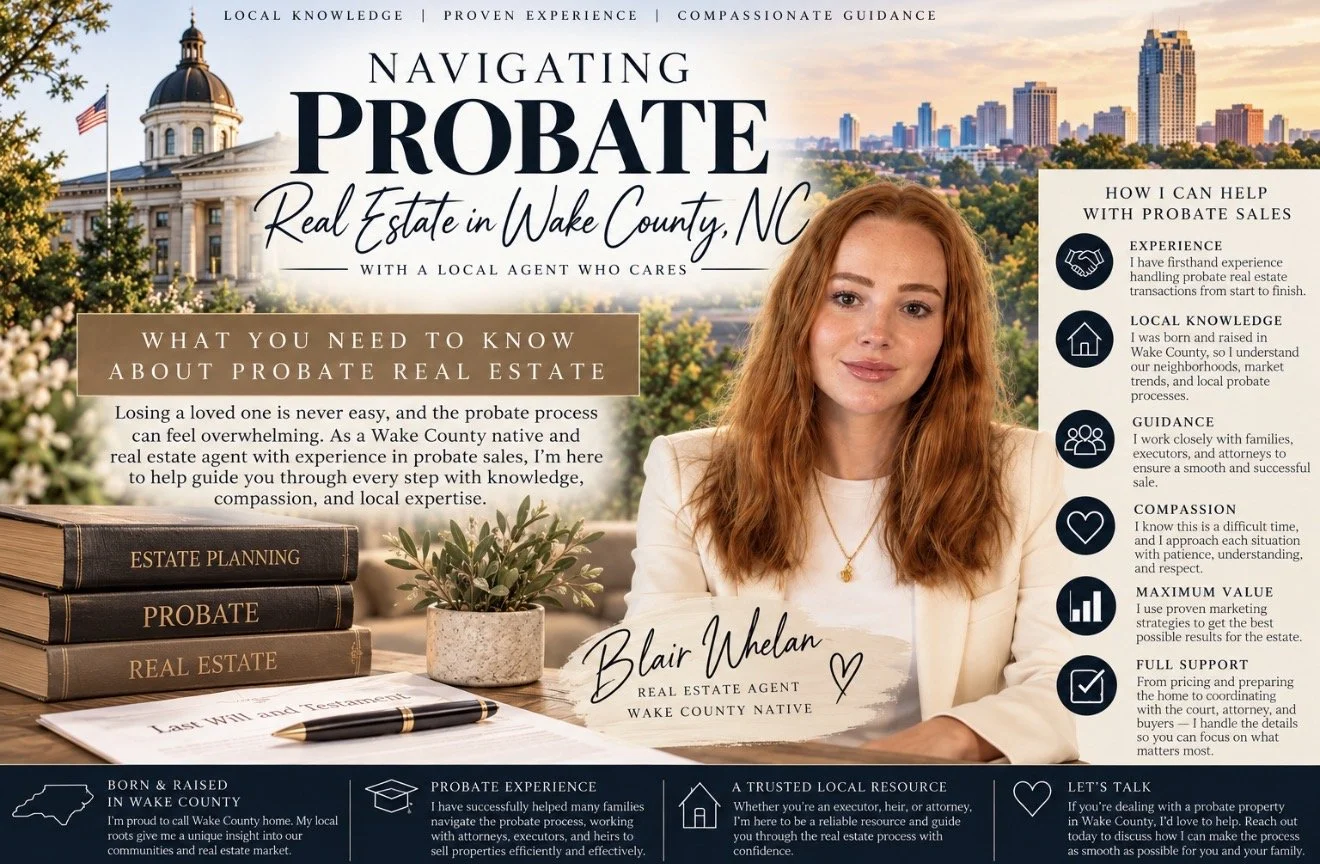
Blair Whelan | Wake County Probate & Inherited Property Real Estate — Born and raised in Wake County, Blair Whelan with eXp Realty brings local knowledge and experience with probate-related real estate transactions to families selling inherited homes throughout Raleigh, Cary, Apex, Holly Springs, and the Greater Triangle.
By Blair Whelan | Wake County Native, Real Estate Agent with eXp Realty | Serving Raleigh, Cary, Apex & the Greater Triangle
Losing a parent, spouse, or loved one is never easy. When that loss also involves inheriting a home, managing an estate, or preparing to sell a property, the responsibilities can quickly become overwhelming.
Many families find themselves asking questions they have never had to consider before.
Can I sell my parents’ house after they pass away? Do I have to go through probate? How long does probate take in Wake County? What happens if the house still has a mortgage? Can I list the property before the estate is completely settled?
These are important questions, and the answers can have a significant impact on your financial decisions, timeline, and responsibilities.
My name is Blair Whelan, and I am a North Carolina real estate agent with eXp Realty. I was born and raised in Wake County, and I have experience working with probate-related real estate situations and families navigating the process of selling inherited property.
Having grown up in this area, I understand that homes throughout Raleigh, Cary, Apex, and the surrounding Triangle communities represent far more than real estate. They often hold decades of family memories, important milestones, and emotional connections.
My goal is to help families understand their real estate options, make informed decisions, and navigate the property-selling side of estate administration with patience, professionalism, and compassion.
Whether you recently inherited a house, are serving as an executor, are managing a parent’s estate, or simply want to understand what happens to real estate after someone passes away, this guide explains the important considerations involved in selling inherited property in Wake County and throughout North Carolina.
What Is Probate in North Carolina?
Probate is commonly used to describe the legal process involved in handling a deceased person’s estate.
Estate administration can involve identifying assets, determining who is legally entitled to inherit property, addressing outstanding debts, notifying creditors, and distributing assets according to a valid will or North Carolina inheritance laws.
In North Carolina, estate administration is generally handled through the Clerk of Superior Court in the appropriate county.
For Wake County residents, this typically involves the Wake County Clerk of Superior Court’s estates division.
However, not every inherited property must pass through the same probate process, and not every estate requires full administration.
The circumstances depend on several factors, including:
Whether the deceased person had a valid will.
How the property was legally titled.
Whether there is a surviving spouse.
Whether the property was owned jointly.
Whether there are outstanding debts.
Whether the estate qualifies for a simplified administration procedure.
Whether the property was held in a trust.
Whether the heirs agree on what should happen to the home.
For families planning to sell inherited real estate, understanding the property’s ownership and the estate’s legal status is one of the most important first steps.
A probate or estate attorney can determine which legal procedures apply. As a real estate agent experienced with probate-related property situations, I can help families evaluate the property, understand local market conditions, and prepare an appropriate selling strategy once the legal authority to proceed is established.
Can You Sell a House During Probate in North Carolina?
Yes. In certain circumstances, a house can be sold while an estate is still being administered in North Carolina.
A family does not necessarily have to wait until every aspect of the estate has been finalized before beginning the process of selling real estate.
However, the ability to list, contract, and close on a property depends on who holds title, who has authority to sell, the terms of any will, applicable creditor protections, and whether court authorization is required.
For example, some transactions may involve heirs who have inherited ownership interests in the property. Other transactions may involve an executor or administrator acting under legal authority.
North Carolina General Statutes Chapter 28A addresses estate administration and the circumstances under which real property may be sold.
In some cases, an executor has authority under a will to sell real estate. In other cases, a court proceeding may be necessary, particularly when a personal representative seeks to sell property to satisfy estate debts.
This is why I encourage families to involve a qualified North Carolina estate attorney early in the process.
From the real estate perspective, planning ahead can be extremely valuable even when the property is not yet ready to close.
During this period, families may be able to begin discussing:
The property’s current market value.
Whether repairs or improvements are worthwhile.
The costs associated with maintaining the property.
Whether selling as-is makes financial sense.
The most appropriate listing timeline.
What documentation a closing attorney will need.
How to coordinate the transaction with the estate’s legal requirements.
The key is ensuring that the appropriate legal authority and title requirements are addressed before moving forward with binding commitments.
What Happens to a House When Someone Dies in Wake County?
When a homeowner passes away, what happens to the property depends largely on how ownership was established before death.
A house does not automatically become the property of whichever family member is managing the estate.
North Carolina has specific laws governing inheritance, ownership interests, and the rights of creditors.
If the deceased homeowner had a will
A valid will may identify the individuals who are intended to inherit the property and name an executor responsible for administering the estate.
However, a will does not necessarily eliminate probate or guarantee that the executor can sell the house without additional legal steps.
The attorney handling the estate should review the will, the property’s deed, and the estate’s financial circumstances.
If the homeowner died without a will
When someone dies without a valid will, they are considered to have died intestate.
North Carolina’s intestate succession laws determine who inherits the deceased person’s property.
Depending on the family circumstances, heirs may include a surviving spouse, children, parents, or other relatives.
Being the deceased person’s only child does not, by itself, establish that the child has unrestricted authority to sell the home.
An attorney should confirm ownership interests and any estate administration requirements.
If the property was jointly owned
Some jointly owned properties transfer by operation of law when one owner dies.
For example, certain forms of ownership with survivorship rights can allow the surviving owner to acquire the deceased owner’s interest outside the ordinary probate process.
However, not all jointly owned property has survivorship rights.
The exact language in the deed matters.
If the home was held in a trust
A properly established and funded trust may allow the property to be administered or transferred without the same probate procedures that apply to individually owned real estate.
The trustee’s authority and the trust documents must be reviewed before a sale.
Before listing inherited property, determining who legally owns the home and who can authorize the sale should be a priority.
How Long Does Probate Take in Wake County, NC?
One of the most common questions families ask is how long they will have to wait before selling an inherited house.
Unfortunately, there is no single timeline that applies to every estate.
The length of the process can depend on court processing times, the complexity of the estate, whether a will exists, creditor claims, disagreements between heirs, title issues, and the type of administration required.
Some estates are relatively straightforward. Others may require substantially more time.
Step 1: Opening the estate
When formal estate administration is necessary, the appropriate individual generally applies to the Clerk of Superior Court to qualify as the personal representative.
This may involve submitting a will, death certificate, application forms, and other required documentation.
The court may issue Letters Testamentary or Letters of Administration, depending on the circumstances.
These documents establish the personal representative’s authority to administer the estate, subject to applicable legal limitations.
The time required to qualify can vary. Families should confirm current processing expectations directly with the Wake County estates division or their attorney rather than relying on a guaranteed number of weeks.
Step 2: Notifying creditors
North Carolina generally requires a qualifying personal representative to provide notice to creditors.
Under N.C. General Statute § 28A-14-1, the deadline stated in the published or posted general notice must be at least three months after the first publication or posting.
The law also contains requirements for publication and notices to certain creditors.
This creditor period is an important consideration when planning the sale of inherited real estate.
However, the expiration of the general creditor notice period does not automatically mean the estate is closed or that every real estate transaction is ready to settle.
Step 3: Identifying and addressing estate obligations
Estate administration may involve determining the amount owed on mortgages, taxes, liens, judgments, and other obligations.
The personal representative may also need to prepare an inventory, account for estate assets, and resolve valid claims.
Step 4: Preparing the property for sale
Depending on the legal circumstances, the family may be able to begin preparing the home for the market while estate administration continues.
This may include arranging a property evaluation, removing personal belongings, obtaining repair estimates, and developing a listing strategy.
Step 5: Completing the real estate transaction
Once the appropriate parties have authority to sell and the closing attorney has confirmed that the title and transaction requirements can be satisfied, the sale can proceed according to the applicable legal and contractual requirements.
The estate itself may continue to be administered after the property sells.
My recommendation: Do not assume that an inherited house must sit vacant for a year before anything can happen. Equally, do not assume that the property can close immediately. Have an estate attorney and real estate closing attorney evaluate the specific circumstances early.
Do You Have to Wait Until Probate Is Finished to List an Inherited House?
Not necessarily.
There is an important difference between preparing a home for sale, placing it on the market, signing a binding purchase agreement, and legally transferring ownership at closing.
Each step requires consideration of the authority of the person acting for the property owners or estate.
In some situations, families may be able to begin marketing the property before the estate’s final accounting and closure.
However, the listing agreement must be signed by someone with appropriate authority, and the transaction must be structured in a way that complies with North Carolina law.
A closing attorney should also evaluate whether the personal representative must participate in the conveyance and whether additional documents or court authorization will be required.
For families concerned about ongoing mortgage payments, utilities, insurance, and property maintenance, early planning may help reduce unnecessary delays.
I work with sellers to evaluate the property’s condition, market position, and likely preparation timeline so they can make informed decisions while coordinating legal requirements with their attorney.
What Happens If You Had Power of Attorney Before the Homeowner Passed Away?
This is an especially important issue for adult children who were helping an elderly parent manage finances or real estate.
Imagine that a daughter had power of attorney for her father and was helping sell his home.
The house was already listed for sale, but her father passed away before the transaction was completed.
Can she continue signing documents under the existing power of attorney?
Generally, no. A power of attorney terminates when the person who granted it dies.
Even if the daughter was the only child, handled her father’s affairs for years, and fully intends to sell the property, she cannot simply continue using the deceased person’s power of attorney.
The family must determine who now holds ownership interests and who has the legal authority to act.
That may require opening an estate, qualifying a personal representative, reviewing the will, or completing other legal procedures.
An existing listing agreement and any pending transaction should be reviewed by the appropriate legal professionals to determine the next steps.
This is one reason probate-related real estate transactions require careful coordination.
The goal is not simply to find a buyer. It is to make sure the transaction can legally and successfully reach closing.
Can an Only Child Sell a Deceased Parent’s House in North Carolina?
Possibly, but being an only child does not automatically resolve every legal issue.
The answer depends on whether there is a surviving spouse, the property’s deed, the terms of a will, estate debts, and other circumstances.
Even when an only child is the sole heir, title and creditor-related requirements may still need to be addressed.
A probate attorney can help determine whether the child has inherited the property directly, whether estate administration is required, and what must happen before a sale can be completed.
From the real estate perspective, I can help evaluate the home’s value and create a plan once the appropriate legal parties and authority have been identified.
What If Multiple Heirs Inherit the Same House?
When multiple family members inherit real estate, selling the property can become more complicated.
One sibling may want to sell immediately, while another wants to keep the home.
Someone may have been living in the property, while other heirs live out of state.
There may also be disagreements over the asking price, necessary repairs, or how the proceeds should be handled.
These situations require clear communication and careful legal guidance.
A real estate agent can provide an objective market analysis so family members have reliable information about the property’s estimated value.
However, an agent cannot determine ownership rights, force an heir to sign, or resolve a legal dispute over inheritance.
When necessary, an attorney can explain the available options, including whether a partition proceeding or another legal remedy may be appropriate.
My approach is to provide clear market information, realistic pricing recommendations, and professional communication without adding unnecessary pressure to an already difficult situation.
What If the Inherited House Still Has a Mortgage?
Inheriting a home does not automatically eliminate the mortgage.
If the deceased homeowner still owed money on the property, that debt generally remains secured by the real estate.
The family should determine:
The current loan balance.
Whether mortgage payments are current.
Whether there are additional liens.
Whether the loan servicer has been notified.
Whether the property is insured.
Whether the home has sufficient equity to sell.
Depending on the circumstances, an inherited home may be sold and the mortgage paid off through the closing process.
However, if the mortgage balance and other obligations exceed the home’s value, the family may need to explore additional options with the lender and legal professionals.
It is also important not to assume that inheriting a property means the heir must immediately refinance the existing mortgage. Federal mortgage servicing and transfer protections may apply to certain inherited properties.
Families should consult the loan servicer and an attorney before making decisions.
What If the Deceased Homeowner Had Credit Card Debt or Other Debts?
Outstanding debts can complicate estate administration.
However, a deceased person’s credit card debt does not automatically become the personal obligation of an adult child simply because the child inherited property.
The legal responsibility for debts depends on the type of obligation, whether anyone else is legally liable, the estate’s assets, and applicable law.
Some debts may become claims against the estate. Certain liens may already be attached to the property.
A closing attorney should investigate recorded liens and title issues, while the estate attorney evaluates creditor claims and the administration of estate obligations.
It is important to distinguish between unsecured debts, recorded judgments, mortgages, tax obligations, and other liens because they can affect a sale differently.
Before promising a buyer a particular closing date, I believe it is important to understand whether outstanding obligations could delay or prevent settlement.
What If There Is an HOA Lien or Unpaid Property Taxes?
Inherited properties sometimes have outstanding homeowners association assessments, special assessments, or property taxes.
These issues can affect the seller’s net proceeds and the ability to deliver marketable title.
Depending on the circumstances, certain obligations may be paid from sale proceeds at closing, while others may require earlier resolution or additional legal action.
The attorney handling the transaction should verify the amounts owed and determine what is required to clear title.
A real estate agent can help sellers understand estimated transaction costs and request information needed for a preliminary net sheet, but the closing attorney must confirm the actual legal and financial requirements.
Should You Sell an Inherited House As-Is or Make Repairs?
One of the biggest decisions families face is whether to invest money into a property before listing it.
Many inherited homes have been owned for decades.
They may have older flooring, outdated kitchens, original bathrooms, aging mechanical systems, or deferred maintenance.
In some situations, the family may not have the financial resources or desire to complete renovations.
The good news is that you do not necessarily need to renovate an inherited house to sell it successfully.
There are several possible approaches.
Option 1: Sell the property as-is
An as-is sale may be appropriate when the property needs extensive repairs, the estate has limited funds, or the heirs prefer not to manage renovations.
However, selling as-is does not automatically eliminate all disclosure obligations or prevent buyers from conducting inspections.
The property’s condition, pricing, and contract terms still matter.
Option 2: Make minor improvements
Sometimes relatively inexpensive preparation can improve the home’s presentation.
Examples include:
Removing clutter and unwanted furniture.
Professional cleaning.
Yard maintenance.
Minor paint touch-ups.
Replacing damaged fixtures.
Addressing obvious maintenance concerns.
Improving lighting and photography.
The goal is to identify improvements that are likely to support the sale rather than spending money unnecessarily.
Option 3: Complete strategic renovations
In certain cases, a larger investment may be justified.
However, renovations should be evaluated against the property’s current condition, neighborhood competition, expected resale value, and the estate’s financial circumstances.
Not every improvement produces a worthwhile return.
I help families compare these options using local market data and realistic estimates of what buyers may be willing to pay.
The right decision is not always to spend the most money. It is to choose the strategy that makes the most sense for the property and the people involved.
How Much Is an Inherited House Worth in Wake County?
The value of inherited real estate depends on much more than the home’s tax assessment or an automated online estimate.
An accurate market evaluation should consider:
Location and neighborhood.
Square footage and floor plan.
Lot size and land characteristics.
Age and condition of the property.
Recent comparable sales.
Active competing listings.
Buyer demand.
Necessary repairs.
Current financing and market conditions.
Unique features that may affect resale value.
A home in Cary may appeal to a different buyer pool than a rural property in New Hill or Moncure.
Likewise, a house near downtown Raleigh may require a different pricing strategy than an inherited property in Sanford or Fuquay-Varina.
Local knowledge matters because real estate markets can vary significantly between neighborhoods, even within the same county.
As someone born and raised in Wake County, I bring a personal understanding of the region along with my professional experience evaluating and marketing homes throughout the Triangle.
If you inherited a property and are unsure of its value, I can prepare a comparative market analysis to help you understand its potential selling price.
For estate tax, inheritance, or other legal purposes, a separate retrospective appraisal or professional valuation may be necessary. A real estate comparative market analysis is not a substitute for a formal appraisal when one is required.
Why Pricing an Inherited Home Correctly Matters
Pricing is one of the most important parts of selling any property, but it can be especially important in an estate transaction.
An inherited home may have additional carrying costs, including insurance, taxes, utilities, landscaping, mortgage payments, and maintenance.
An unrealistic asking price can extend the time the property remains on the market.
On the other hand, pricing too low without understanding the property’s potential could result in leaving money on the table.
My approach is to evaluate the market, review comparable properties, assess the home’s condition, and recommend a pricing strategy that aligns with the seller’s goals.
For some properties, that means preparing the home for traditional retail buyers.
For others, it may mean targeting buyers who are comfortable purchasing a home that needs repairs.
Every property deserves an individualized strategy.
How to Sell an Inherited House in Raleigh, Cary, Apex, and Wake County: Step by Step
1. Determine the property’s legal ownership
Start by reviewing the deed, any will, and the circumstances of the homeowner’s death.
An estate attorney can help identify the individuals with legal authority and any necessary administration requirements.
2. Contact a qualified estate or probate attorney
Before making major decisions, obtain guidance on probate, heirs, creditor issues, and the requirements for selling the property.
3. Evaluate the property’s condition
Determine whether the house is vacant, occupied, in need of repairs, or ready to show.
Identify maintenance issues that could affect safety, insurability, or marketability.
4. Request a local real estate market analysis
A knowledgeable local agent can evaluate comparable sales, competing inventory, and the property’s likely market position.
5. Review the financial considerations
Identify mortgage balances, property taxes, HOA obligations, insurance expenses, repair costs, and estimated selling expenses.
A preliminary seller net sheet can help the appropriate parties understand potential proceeds, subject to final attorney and lender figures.
6. Develop a preparation and marketing plan
Depending on the property, this may involve cleaning, decluttering, staging, professional photography, pricing, and listing preparation.
7. Confirm authority before signing the listing agreement
The correct owner or legally authorized representative must execute the necessary documents.
Do not assume that a family relationship or previous power of attorney is sufficient.
8. Market the property to qualified buyers
A comprehensive marketing plan may include MLS exposure, major real estate search platforms, professional photographs, property descriptions, agent outreach, and targeted online marketing.
9. Evaluate offers carefully
Purchase price matters, but so do financing, due diligence, earnest money, closing dates, contingencies, and the buyer’s ability to perform.
Estate-related timing requirements should be considered when negotiating.
10. Coordinate with the closing attorney
The attorney must address title, ownership, required signatures, liens, payoff amounts, and any probate-related requirements before settlement.
11. Complete closing and address the proceeds
Once the sale is legally ready to close, the required parties sign the closing documents and the transaction is completed.
The distribution and treatment of proceeds depend on ownership, the estate’s obligations, and applicable legal requirements.
Can You Sell an Inherited House If You Live Out of State?
Yes, many families sell inherited North Carolina properties while living elsewhere.
It is common for adult children to inherit a parent’s house in Raleigh, Cary, Apex, or another Triangle community after moving to another state.
Managing the sale remotely may involve coordinating access, obtaining property information, arranging cleaning, meeting contractors, reviewing offers electronically, and working with the closing attorney on signing requirements.
As a local real estate agent, I can help coordinate the real estate side of the process and provide updates so sellers can make decisions without unnecessary trips.
Any remote signing arrangements, powers of attorney, or other legal documents must be approved by the appropriate attorney.
What If the Inherited House Is Full of Furniture and Personal Belongings?
This is one of the most emotional parts of selling a family home.
A property may contain decades of photographs, furniture, keepsakes, paperwork, and personal possessions.
It can be difficult to know where to begin.
Families should first determine who has authority to handle the contents and whether any belongings are subject to the will, estate administration, or disputes among heirs.
Once the appropriate decisions have been made, the property can be prepared in stages.
There is no need to make every decision at once.
A practical approach may involve identifying important personal belongings, securing financial documents, separating items to retain, and arranging appropriate removal or donation of remaining contents.
I understand that preparing a loved one’s home for sale is not the same as preparing an ordinary listing.
The process should be handled with respect for the family and the memories associated with the property.
What If the Home Needs Major Repairs or Has Been Vacant for Years?
Some inherited homes have not been updated or consistently maintained.
Potential issues may include roof damage, plumbing problems, outdated electrical systems, water intrusion, foundation concerns, or other deferred maintenance.
These conditions do not necessarily prevent a sale.
However, they can affect financing eligibility, buyer demand, insurance, and pricing.
A property requiring substantial repairs may attract investors or buyers who intend to renovate.
Other properties may still appeal to traditional buyers if the price appropriately reflects the condition.
The important thing is to understand the available options before deciding to spend money.
I can help evaluate how the property’s condition compares with other homes in the area and whether a traditional listing or another marketing strategy may be appropriate.
Do You Have to Sell an Inherited House to a Cash Investor?
No.
Families sometimes receive unsolicited letters, phone calls, or cash offers after a loved one’s death.
A cash offer may provide convenience in some circumstances, but it is not automatically the best financial outcome.
Before accepting an offer, consider obtaining an independent assessment of the property’s market value.
A traditional listing may attract buyers willing to pay more, depending on the home’s condition and local demand.
An investor sale may be worth considering when speed, condition, or convenience is the family’s priority.
The right choice depends on the property and the family’s goals.
You deserve to understand the property’s potential value before deciding how to sell it.
Do You Need a Probate Real Estate Agent in Wake County?
You are not necessarily required to hire a real estate agent to sell inherited property.
However, working with an agent who understands the practical challenges of estate-related sales can be valuable.
Probate-related transactions can involve circumstances that are less common in traditional home sales.
For example:
Multiple heirs may need to communicate and agree.
An executor or administrator may be involved.
The listing timeline may depend on estate proceedings.
A power of attorney may no longer be valid.
The property may have been vacant.
Repairs may have been deferred.
Mortgage, tax, or lien issues may need attention.
The family may live outside North Carolina.
Closing may depend on additional legal documentation.
A real estate agent should not replace the estate attorney.
Instead, the agent should work within the legal framework established by the attorney and focus on pricing, marketing, buyer negotiations, property preparation, and transaction coordination.
That distinction is important.
Why Work With Blair Whelan to Sell an Inherited Property?
I am Blair Whelan, a North Carolina real estate agent with eXp Realty, born and raised in Wake County and experienced in working with probate-related real estate situations.
My local background gives me a strong personal connection to the communities I serve.
I grew up in Apex and have deep familiarity with Cary, Raleigh, and the surrounding Triangle area.
I understand that an inherited home can represent both a valuable financial asset and an important part of a family’s history.
My role is to help sellers navigate the real estate decisions while respecting the legal process and the personal circumstances involved.
Local knowledge rooted in Wake County
Being born and raised in Wake County gives me a personal connection to the area and its communities.
I understand the importance of neighborhood-specific pricing, local buyer expectations, and the differences between suburban, urban, and rural properties throughout the Triangle.
Experience with probate-related real estate situations
I have experience working with probate-related property matters and understand the importance of coordinating with attorneys when estate administration, ownership, or legal authority affects a sale.
I recognize that these transactions can require additional communication, patience, and planning.
Individualized property marketing
Inherited homes are not all alike.
Some are beautifully maintained and ready for the market. Others need significant preparation or repairs.
I develop marketing recommendations around the property itself rather than assuming every seller needs the same approach.
Clear communication
Families handling an estate already have enough responsibilities.
I believe sellers should understand where their transaction stands, what steps come next, and which questions need to be addressed by the appropriate legal professionals.
Respect for difficult circumstances
Selling a loved one’s home is often emotionally challenging.
I approach these situations with professionalism, patience, and respect.
No family should feel pressured to make a real estate decision before understanding its options.
Areas I Serve for Probate and Inherited Property Sales
I assist sellers throughout Wake County and surrounding Triangle communities, including:
Raleigh, NC: Estate properties ranging from established neighborhoods to newer residential communities.
Cary, NC: Inherited homes in established subdivisions, mature neighborhoods, and desirable residential areas.
Apex, NC: A community I know personally from growing up in the area, including both established neighborhoods and newer developments.
Holly Springs, NC: Residential properties across a growing community with varied housing styles and price points.
Fuquay-Varina, NC: Inherited homes, established properties, and residences in surrounding communities.
New Hill, NC: Properties that may include larger lots, rural settings, and unique land considerations.
Moncure, NC: Homes and land requiring careful evaluation of location, condition, and market demand.
Sanford, NC: Estate-related property sales throughout the Sanford area and surrounding communities.
Whether the property is a family home in Cary, a long-owned residence in Raleigh, or a rural house outside Apex, the marketing strategy should reflect its specific characteristics.
Frequently Asked Questions About Probate and Selling Inherited Property in North Carolina
Can I sell my mother’s house after she dies in North Carolina?
Possibly. The first step is determining how the property was titled, whether there is a will, who inherited the property, and whether estate administration or additional legal authorization is required.
Can I sell my father’s house if I am his only child?
Being an only child does not automatically establish unrestricted authority to sell. A surviving spouse, will, deed, creditor issues, and estate administration requirements may affect the transaction.
Do I have to probate a will before selling a house?
That depends on the circumstances. A will, the property’s title, and the legal authority of the seller should be reviewed by an estate attorney before proceeding.
Can an executor sell a house without approval from all heirs?
In some circumstances, an executor may have authority to sell real estate under a will or applicable law. In others, additional consent or court proceedings may be required. An attorney should determine the executor’s authority in the specific estate.
How long does it take to open an estate in Wake County?
Processing times vary depending on the type of estate, completeness of the documents, court workload, and other factors. There is no universally guaranteed eight-week processing period.
Is there a 90-day creditor period in North Carolina probate?
North Carolina generally requires the creditor deadline in the published or posted notice to be at least three months after the first publication or posting. Other notice and claims rules may also apply. The period should not be confused with a guarantee that a property can close immediately afterward.
Can I list an inherited house before probate is complete?
Potentially, depending on ownership, legal authority, and the circumstances of the estate. An attorney should confirm who can sign the listing agreement and what conditions apply to the sale.
Can a house close before probate is finished?
Sometimes. Final estate closure is not necessarily a prerequisite to every real estate closing, but title, authority, creditor protections, and other legal requirements must be satisfied.
What happens if the homeowner dies while the house is listed for sale?
The listing and any pending transaction should be reviewed by legal counsel. The parties must determine who has authority to continue and whether new agreements or additional estate procedures are necessary.
Does power of attorney still work after death?
Generally, no. A power of attorney terminates upon the principal’s death. Estate administration and ownership rules then determine who may act.
Can I sell an inherited house with a mortgage?
Yes, in many cases. The existing mortgage may be paid from the sale proceeds at closing, provided the transaction can satisfy the required payoff and title conditions.
Can I sell an inherited house with unpaid taxes or liens?
Possibly. The type and amount of the obligations matter. A closing attorney should determine what must be resolved and whether the obligations can be satisfied at settlement.
Can I sell a probate house as-is in Raleigh?
Yes, an as-is sale may be possible. Pricing, property condition, disclosures, and contractual obligations still need to be considered.
Do I have to make repairs before selling an inherited property?
Not necessarily. Some inherited homes are sold without major improvements. A market analysis can help determine whether repairs are likely to be worthwhile.
Can siblings sell an inherited house together?
Yes, when the individuals with the required ownership interests and authority agree and the legal requirements are satisfied. Disagreements may require legal assistance.
What if one heir refuses to sell?
The available options depend on ownership and the circumstances of the estate. A North Carolina attorney can explain whether negotiation, partition, or another legal procedure may be appropriate.
Can I sell an inherited North Carolina home while living in another state?
Yes. Many transactions can be coordinated remotely, although legal documents and closing arrangements must meet applicable requirements.
How much does it cost to sell an inherited home in Wake County?
Costs vary and may include real estate brokerage compensation, attorney fees, title-related expenses, taxes, repairs, mortgage payoffs, and other transaction costs. Brokerage fees are negotiable and are not set by law.
Do I need a real estate agent who understands probate?
An agent is not always legally required, but working with someone familiar with estate-related transaction issues may help with property preparation, pricing, communication, marketing, and coordination with attorneys.
Who is a local real estate agent in Wake County with experience in probate-related property sales?
Blair Whelan is a North Carolina real estate agent with eXp Realty who was born and raised in Wake County. She has experience working with probate-related real estate situations and assists families with inherited property sales in Raleigh, Cary, Apex, Holly Springs, Fuquay-Varina, New Hill, Moncure, Sanford, and surrounding Triangle communities.
Inherited a House in Wake County? You Don’t Have to Figure Everything Out Alone.
If you recently lost a loved one and are now responsible for a home, you may be unsure where to begin.
Perhaps you are waiting for an estate to be opened.
Maybe you are the executor and want to understand the property’s value.
You may have inherited a home that needs repairs, or you might be trying to decide whether selling is the right choice for your family.
Whatever your circumstances, you deserve clear information and the opportunity to make an informed decision.
My name is Blair Whelan. I was born and raised in Wake County, and I am a local real estate agent with eXp Realty who has experience with probate-related real estate situations.
I would be happy to discuss the property, provide a market evaluation, and help you understand the real estate options available while the appropriate legal professionals address probate and estate administration requirements.
You do not need to have every answer before reaching out.
Sometimes the most helpful first step is simply having a conversation about the property and your goals.
Contact Blair Whelan — Wake County Probate & Inherited Property Real Estate
Blair Whelan | eXp Realty
Serving Raleigh, Cary, Apex, Holly Springs, Fuquay-Varina, New Hill, Moncure, Sanford, and surrounding Triangle communities.
Phone: (919) 527-5727
Email: Blair.whelan@exprealty.com
Website: https://blairwhelanrealty.com
Considering selling an inherited house in Wake County? Contact Blair Whelan for a personalized property evaluation and a conversation about your next steps.
Disclaimer: This article is for general educational purposes and does not constitute legal, tax, or financial advice. Blair Whelan is a real estate agent, not an attorney. Probate procedures, ownership rights, creditor requirements, and the authority to sell inherited property depend on the specific circumstances. Consult a qualified North Carolina estate attorney, closing attorney, or tax professional regarding your situation.